Choose fiber laser power from material, thickness distribution, required edge quality, batch volume, assist gas, and a representative sample test—not wattage alone.
What fiber laser power should you choose?
Choose the lowest power and machine configuration that can meet the required cut quality and accepted-parts output on your real material mix. Power affects piercing and cutting capability, but the cutting head, beam delivery, motion system, assist gas, nozzle, material condition, nesting, and process parameters also affect the result.
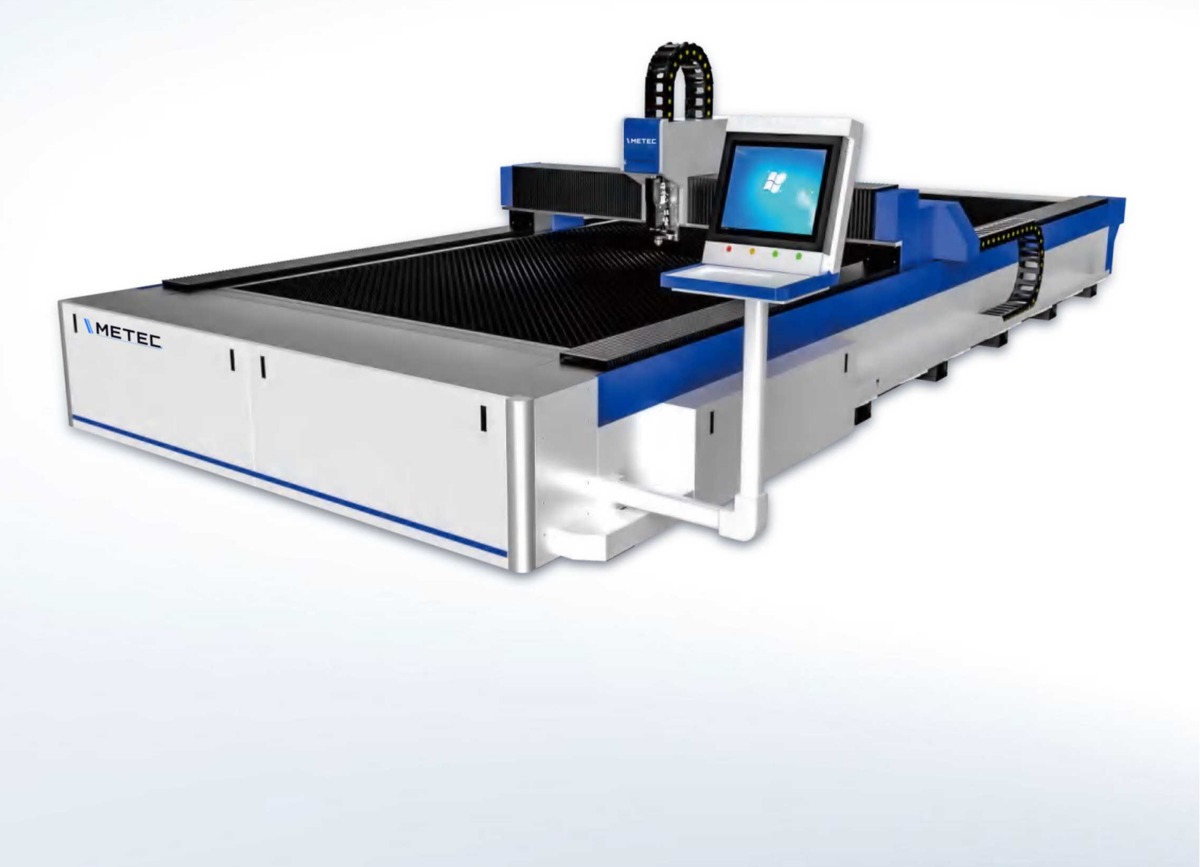
Metec publishes laser-source options from 1 to 30 kW across named product models. That range is not a universal material-thickness chart. Ask for a written configuration and a sample test when thickness or edge quality is close to the process limit.
Which production inputs determine laser power?
| Input | Why it matters | Evidence to provide |
|---|---|---|
| Material grade | Absorption, conductivity, and reaction with assist gas vary | Grade and supplier specification |
| Thickness mix | The common thickness drives daily output; the maximum sets the upper test case | Thickness distribution by annual volume |
| Edge requirement | Oxide, dross, taper, roughness, and heat effects can change the acceptable limit | Drawing and inspection method |
| Part mix | Piercing count and contour length can matter more than sheet thickness | DXF files or representative nests |
| Assist gas | Gas type, purity, pressure, and local cost affect quality and operating cost | Available supply and price |
| Batch profile | Loading, unloading, sorting, and changeover can limit output | Shift pattern and batch sizes |
How should you compare power bands?
- 1–3 kW: evaluate for thin-sheet work, compact layouts, and lower throughput requirements.
- 4–6 kW: evaluate when the material mix or accepted-parts target exceeds the lower band.
- 8–12 kW: evaluate for higher throughput, thicker work, or faster processing of the common thickness.
- 15–30 kW: evaluate for demanding plate work only after checking electrical supply, gas demand, extraction, safety enclosure, consumable cost, and utilization.
These are selection bands, not guaranteed thickness limits. A higher-power source does not correct an unsuitable machine format, unstable material, poor parameter control, insufficient extraction, or a loading bottleneck.
What should a sample test record?
Use production material and a representative part. Record the exact machine configuration, source power, cutting head, nozzle, assist gas, gas pressure, program, material certificate, ambient conditions, cycle time, accepted quantity, and inspection result. Agree in advance which dimensions and edge conditions determine acceptance.
How do you compare operating cost?
Compare accepted parts per shift, not only cutting speed. Include electricity, assist gas, nozzles, protective lenses, filters, scheduled maintenance, labor, loading time, scrap, financing, and expected utilization. Run a base, conservative, and high-utilization case.
Frequently asked questions
Does more laser power always increase profit?
No. More power can increase processing capability, but profit depends on utilization, accepted output, gas and energy cost, material handling, demand, financing, and whether the rest of the process can keep up.
Can a catalogue thickness value replace a sample cut?
No. Catalogue values are a screening input. Use a sample cut when material grade, finish, edge requirement, or thickness is close to the stated limit.
Which working area does Metec publish?
Published MLS sheet-laser models reach 13,000 × 2,500 mm, while MLG ground-rail configurations reach 36,000 × 5,000 mm. Confirm the selected size, power, and handling scope in the quotation.
What should I send for a recommendation?
Send material grades, thickness distribution, drawings or nests, annual volume, shift pattern, edge acceptance criteria, available utilities, floor space, and a representative sample part.
The Metec Engineering Team reviews machine-selection, process, specification, installation, and operating guidance for Metec sheet-metal equipment.